
Sleep and anxiety: what to change first
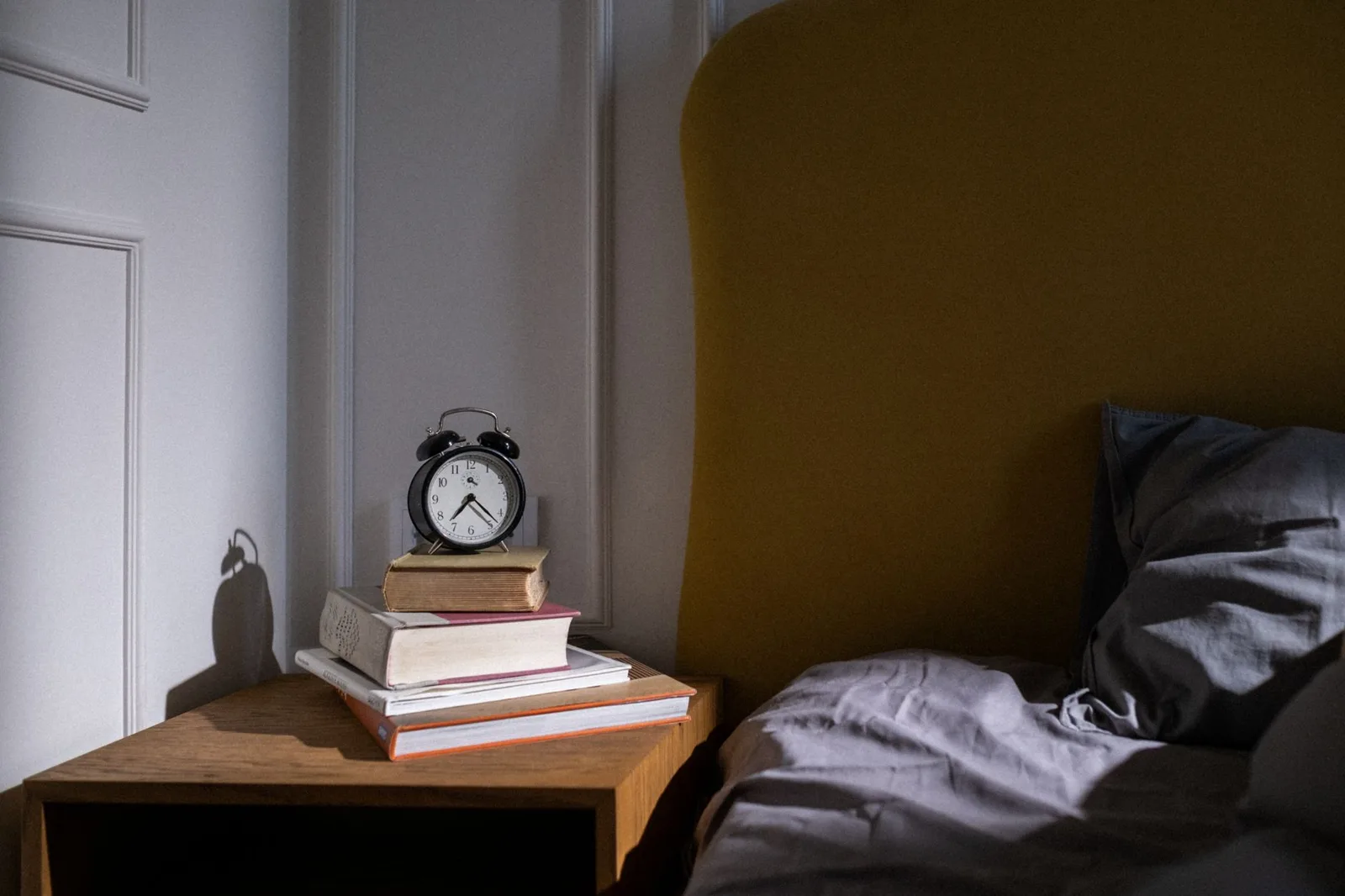
When sleep and anxiety are tangled together, the most useful first change is usually your wake time, not your bedtime. Anxious minds often try to fix sleep by going to bed earlier, adding more hours in the dark to think. A fixed wake time gives your body a steadier signal to work from, whatever the night was like.
Why the two feed each other
Anxiety raises physical arousal: a faster heart rate, tense muscles, a mind that keeps scanning for problems. That state is the opposite of what sleep needs. Then, once sleep is short or broken, the following day brings less capacity to manage stress, fewer emotional reserves, and a lower threshold for irritation or worry. That worn-down state feeds the next night’s anxiety, and the cycle repeats. Neither half of the cycle is the whole cause. Trying to fix only the anxiety, or only the sleep, tends to leave the other half untouched and pulling the pattern back into place.
Start with your wake time
A consistent wake time, seven days a week, is one of the more reliable levers for people whose sleep has become unpredictable. It sounds like a small change, but it anchors your body clock regardless of how the previous night went. Getting up at the same time even after four hours of broken sleep feels counterintuitive, but it is one of the core parts of CBT for insomnia, an approach NICE recognises for ongoing sleep difficulties. Bedtime, by contrast, is harder to control directly. Trying to force an earlier bedtime when you’re not sleepy usually adds more lying awake, and more time for anxious thoughts to circle.
Give worry a fixed slot, not the whole evening
Many people only sit down with their worries once the lights are off and the day’s distractions have gone. That makes bedtime the least useful moment to start processing them. Setting aside ten or fifteen minutes earlier in the evening to write down what’s on your mind, and what you might do about it tomorrow, moves that processing to a point in the day when you have more capacity to think clearly. It doesn’t remove the worry. It changes when you engage with it, so it has less claim on the hour before sleep.
Change what happens in the hour before bed
Bright light, screens, caffeine late in the day and alcohol close to bedtime all work against the physical process of falling asleep. Caffeine’s effects can last for several hours after drinking it, and alcohol, while it may bring on drowsiness at first, tends to fragment sleep in the second half of the night. None of these changes will resolve anxiety on their own, but a calmer, dimmer, more predictable run-up to bed gives your body fewer competing signals to work against.
Deal with the 3am mind
Waking in the small hours and finding your thoughts immediately busy is common with anxiety. Checking the time or your phone tends to make it worse, since both sharpen the sense of time being lost. If you’re still awake after roughly twenty minutes, it helps to get up, move to another room, and do something quiet and low-stimulation until you feel sleepy again, rather than lying in bed trying to force it. Problem-solving at 3am rarely produces useful answers. The same question, looked at after daylight and a coffee, usually looks different.
When self-help changes aren’t enough
Some of the steps above will help most people some of the time. They won’t resolve a sleep pattern that’s been disrupted for months, or anxiety that’s affecting work, relationships or daily functioning. If that’s where you are, it’s worth speaking to a psychologist rather than continuing to adjust habits on your own. Approaches such as CBT for insomnia and CBT for anxiety are structured, time-limited, and recognised by NICE for these difficulties. We’re clinical psychologists for Bromley and south east London, working online with adults.
A realistic starting point
It usually works better to pick one change than to try several at once. Trying to fix your wake time, your evening screens, your worry habits and your caffeine intake all in the same week usually collapses under its own weight. A fixed wake time is a core part of CBT for insomnia, so it’s a reasonable place to begin. Give it two weeks before judging whether it’s helping, since the first few days of an earlier or more consistent wake time often feel harder, not easier, before the pattern settles.
Questions people ask
Should I go to bed earlier if anxiety is keeping me awake?
Usually not. Extra time in bed while your mind is active tends to stretch out wakefulness rather than shorten it. A fixed wake time, kept the same even after a poor night, is a more useful place to start than an earlier bedtime.
Is it normal for anxiety to get worse at night?
Yes. During the day, activity and other people’s presence compete for attention. At night, with fewer distractions, the mind has more room for worry, and tiredness makes it harder to reason your way out of a spiralling thought.
What should I do if I wake at 3am and can't get back to sleep?
Avoid checking the clock or your phone, since both tend to sharpen anxiety about the time lost. If you’re still awake after around twenty minutes, get up, sit somewhere calm and dim, and return to bed only when you feel sleepy again.
Does cutting out caffeine and alcohol actually help?
Caffeine has a long half-life and can affect sleep quality many hours after drinking it, and alcohol, though sedating at first, tends to fragment sleep later in the night. Reducing both is a reasonable early step, though it rarely resolves anxiety-driven insomnia on its own.
When is it time to get professional support rather than keep trying self-help?
If poor sleep and anxious thinking have persisted for several weeks, are affecting your daily functioning, or self-help changes haven’t shifted the pattern, it’s worth speaking to a psychologist. Approaches such as CBT for insomnia and CBT for anxiety are recognised by NICE for these difficulties.
Can I work on sleep and anxiety separately, or do they need to be treated together?
They often respond to overlapping techniques, since both involve calming physical arousal and changing unhelpful thought patterns. A psychologist can assess whether one is driving the other and structure support accordingly, rather than treating them as entirely separate problems.
Our blog posts are written to share general information and ideas. They are not personal advice and don't replace an assessment with a qualified clinician who knows your situation. We can't accept responsibility for decisions made based on this content alone. If you would like support or are worried about your mental health, please speak to your GP or get in touch with us.
We are not a crisis service. If you need urgent help, call NHS 111 (option 2), contact your GP, or call Samaritans free on 116 123, any time. In an emergency, call 999.